Climate change has become a part of dinner table conversations now, yet the climate change causes rarely get explained properly. You might have heard it first in school or perhaps in a news broadcast. It must have come up at least once when discussing weather being erratic. But what is this change? After all, doesn’t the climate always change (and isn’t that kind of the point?) That is why knowing the climate change causes matters, and in this blog we break down the biggest climate change causes, one at a time.
And since this is a challenge we face across the globe, collectively, it’s quite important to have a shared sense of the causes behind climate change. Therefore, instead of bringing up a new analogy, let’s use one that has already got some traction; the video below, “Our House Is On Fire” by Greta Thunberg.

https://youtu.be/ZC9ePXiM3X4 ← Click here to watch the video
Global Warming and Climate Change Causes
This analogy works for two main reasons, one, that it brings down the problem from a global scale to space that we can experience and imagine quite vividly. Secondly, the sense of panic of a very personal belonging like our house, burning away, sets a reference for the urgency we need to tackle it.
Instead of just a burning house, here we have a planet that’s like dry tinder wood warming up in the heat. In this context, where there is nowhere to run, no Plan B; your best and perhaps only hope is to prevent this, no matter what the cost.
Now, this is indeed a bleak way to introduce, but rather than a blanket statement soothsaying that we can solve our way out of this, we can only build a shared, actionable framework to approach the problem by taking stock of the systemic fracture we have to deal with. Our goal should be to figure out how to move from a state of despair paralysis and begin solving.
Greenhouse Gases and the Main Climate Change Causes
Before getting too deep, solving this requires us to understand the climate change causes, or why this is happening in the first place and thanks to a bunch of smart people, we know this quite well →
Nearly every process of our industrial system has trash gases that, instead of scrubbing clean, we have just kept dumping into the atmosphere. While our atmosphere looks clear for the most part, dumping stuff into it is no less messy than throwing trash into our rivers and oceans, it’s just that the things we trash most into are carbon, sulphates and nitrite compounds, which look invisible because of how tiny they are. If these compounds were visible, they wouldn’t look any different than this river.

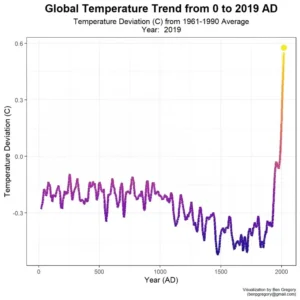
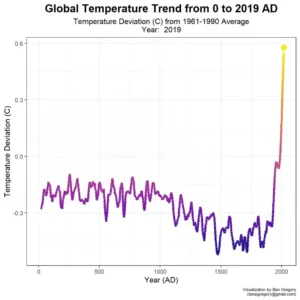
So what do these floating trash compounds do? Well, they trap heat. They are like a thick blanket covering the planet in the middle of summer. Look at this graph below, for instance, this is how Earth has been heating up ever since we began this lazy trashing, the industrial revolution.
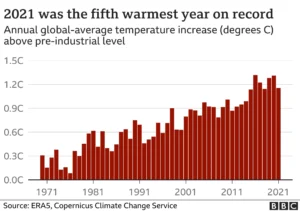
Well this increase is definitely not great, but this is like 1 degree Celsius change in the last 50 years. Shouldn’t be quite panicking the way we are now right? Unless you are that particular about your coffee, in our daily lives 1 degree doesn’t mean much, correct?
Well, to give a better idea of what this change implies for climate, take a look at the below graph;
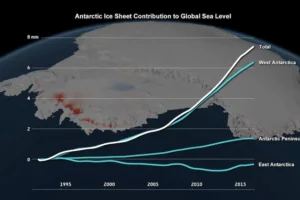
The thing which makes this critical aspect of climate change a serious emergency is the speed at which climate is changing. According to a 2018 report by polar scientists, the rate at which Antarctica is melting increased sharply from 76 billion tonnes a year to around 219 billion tonnes a year between 2012 to the year 2017.
Global Warming and Climate Change Causes: The Temperature Aspect
Well, we can not say that the climate has just started to change in the past decade because of the increase in human activities. The climate has always been changing. What would be more appropriate to say is that the climate now has started changing at a fast pace and this pace is only further increasing due to human-caused factors.
In 2021, the annual global average temperature rose above the pre industrial level, making 2021, the fifth warmest year.
If we talk about the variation in temperature over the Holocene, the stats look disturbing, isn’t it?
There was an increase of up to 4°C near the North Pole in the climate optimum warm event.
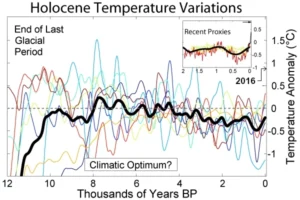
These stats over the years are quite concerning, and they trace back to the climate change causes covered below. Do you know? Even a 3°C rise in the global temperature can lead to a 2 to 4 meter rise in the ocean levels within the next 30 years. Which eventually leads to disastrous events such as South Asia Flooding or California Wildfires.
Carbon Emission and Warming: The Climate Change Causes Behind a Hotter Earth
Before focusing on the causes of climate change causes that lead to the increase in carbon emission. Let’s first focus on why carbon emission is such a serious issue. Well, an increase in the emission of CO2 in the atmosphere leads to an increase in the number of greenhouse gases. These greenhouse gases are responsible for the internal trapping of heat inside the earth’s atmosphere. CO2 in the atmosphere absorbs the radiation from the sun and prevents the heat from escaping out of the atmosphere.
This increased heat in the atmosphere is majorly responsible for the disruption of the earth’s weather patterns, increased global temperature and other severe effects. The changes that climate suffers because of carbon dioxide emission are irreversible for 1000 years after emission stops.
The amount of carbon dioxide emission trapped in our atmosphere causes global warming which damages nature very badly. Global warming melts glaciers which lead to the increase in ocean water, disturbance in the animal’s natural habitats, melting polar ice caps etc. Climate change alters our planet. Carbon dioxide affects 20 per cent of Earth’s greenhouse effect. Carbon dioxide CO2 after it is emitted into the atmosphere is firstly rapidly distributed between the atmosphere, the upper ocean and vegetation.
Over the last few centuries burning of fossil fuels like oil and coal has increased the concentration of carbon dioxide CO2. There are both natural and human sources that cause carbon dioxide emissions. Natural resources like decomposition, ocean release and respiration, and man-made causes come from the activities like cement making, deforestation as well as burning of fossil fuels.
But human-made causes are very dangerous as nature removes some carbon dioxide made from natural causes but man-made activities form extra carbon dioxide in the atmosphere which is more dangerous.
Cement factories, deforestation to build homes, industrial areas, and many more factors are there due to which greenhouse gases are increasing day by day which increases heat and warming on the planet earth.
Most aspects of climate change will remain for centuries even if carbon dioxide emissions stop.
Carbon dioxide emission causes an extreme effect on diversity
Recently, researchers at Columbia University calculated that adding about a quarter of the output of a coal-fired power plant, or roughly a million metric tons of carbon dioxide, to the atmosphere on the top of 2020 levels for just one year will cause 226 deaths globally.
According to an insightful study by the British Aid group, only in the year 2021, humanity had a loss of $170.3 billion due to climate change damages. Not to mention, this amount is more than what it was last year.
Let me give you an idea of how disastrous these climate change damages can be. Hurricane Ida, the most disastrous weather event caused by climate change in the year 2021 in the USA. The hurricane resulted in more than 1000 people losing their lives and more than 1.3 billion people getting displaced from their location.
Carbon dioxide emission causes an extreme effect on diversity. It has a huge effect on the lifestyle of animals as well. As they have to change their way of living because of changes in nature.
Carbon dioxide emission causes various problems like deforestation, change in animal habitats, climate change, melting of glaciers etc.
Due to the increase in global warming heat is generated in a great way which leads to melting ice of glaciers and polar regions which increase the water level of oceans day by day which could be a great disaster for the upcoming generations as it can bring tsunami, flood and other water crises.
And not only water but we should also care about forest and land areas as we know that due to global warming the heat is generated which puts bad impacts on the crops and food plants also. It reduces the quality of the food which makes people fall ill.
So we can see that by destroying nature to make ourselves comfortable we are destroying ourselves. Somehow we are responsible for global warming.
Why Carbon Emissions Rank Among the Top Climate Change Causes
You might be thinking that there are other greenhouse gases also, so why is carbon considered the largest contributor? This is solely due to the reason that carbon is the most common gas out of all the others. Well, our breathing is one such simple contribution to carbon dioxide.
Every time we breathe, we exhale carbon dioxide (CO2) which leads to an increase in the temperature. So our breath is a tiny version of the widespread carbon emissions that is spreading across the world. Carbon emissions refer to the long term shifts in temperatures and weather patterns, mainly caused by human activities, especially the burning of fossil fuels. We! “THE GREAT HUMAN BEINGS” are the main reasons for carbon emissions. In this world, we thought that we are growing by developing various kinds of technology but somewhere we are harassing nature. More than 16.5% of human-made carbon emission is now caused by road transp
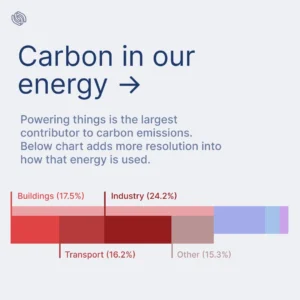
Well, of course, you just can’t blame a specific community or region for the climate change causes. On the contrary, if you take a good look at stats, you’ll find that the major source of carbon in our economy is the energy production sector, consisting of about 73.2% of the total carbon emission.
The prime sources of carbon dioxide emission, and the biggest climate change causes, are:
1. Transportation and Fossil Fuels:
One of the main reasons that are responsible for this is increased transportation. As we know that vehicles are a necessary thing in the urban cities and now in the rural areas also. They provide us comfort and support in our day to day life but somewhere it also badly affects nature.
The smoke that comes out from transportation increases the level of carbon dioxide in the atmosphere.
Carbon dioxide emission comes from transportation generally comes out from burning of fossil fuels of cars, trains, planes, ships and motor vehicles. Over 90 per cent of the fuel used for transportation is petroleum-based which mainly includes diesel and petrol.
2. Electricity Production and Greenhouse Gases:
Electric production generates the second-largest greenhouse gas emissions. Approximately 62 per cent of electricity comes from burning fossil fuels, mainly coal and gases. Producing electricity is not an easy job as it requires energy in high amounts and to generate that energy we have to exploit the natural resources like wind, water, coal etc. During the process, there is a mixing of gases which leads to carbon dioxide emission.
3. Industrialisation and Carbon Emissions:
Carbon dioxide emission from industry mainly comes from burning fossil fuels for energy, as well as greenhouse gas emissions also come from some chemical reactions. The used chemical water which is thrown in rivers and dams also affect nature. Because sometimes chemicals react and which leads to an increase in the heat and warming in the temperature.
Going in-depth into the energy sector, you’ll get to know that industrialisation alone causes 24.2% of carbon emission through energy.
4. Agriculture and Greenhouse Gases:
Carbon emissions produce gases such as carbon dioxide, methane, and nitrous oxide. Agricultural soils, livestock dung and rice cultivation contribute to the production of carbon emission. Also, farm fuels, the addition of fertilizers, burning of crop rubbles etc., contribute to it.
5. Deforestation and Carbon Emissions:
Plants and trees are a major solution toward carbon emissions. They absorb carbon dioxide from the environment and make a balance in the atmosphere. So trees are very important to stop carbon emissions. Therefore, deforestation accelerates the carbon emission rate in the atmosphere.
6. Commercial Areas and Fossil Fuels:
Commercial areas are also behind carbon dioxide emission because it increases heat in the environment by burning fossil fuels for its purpose. And sometimes for personal reasons it mixes some components which increases heat and carbon emissions in the atmosphere.
Surely, there are a lot of sources for carbon emission, and other climate change causes, which can’t be neglected. However, it doesn’t mean that we don’t have the tools to prevent this changing climate.
Digital Solar: A Clean Energy Ray of Hope Against Climate Change Causes
Digital Solar! Haven’t you heard of it? Let me give you a quick introduction to it.
It is extremely important for us to now move to low carbon energy sources to make sure a healthy and climate-friendly future awaits us.
Solar energy contributes to making the environment carbon-free and healthy. A device that makes this process easy is Solar Panel, we all know about it. But they have their disadvantages which do not support their sales a lot. Therefore, Digital Solar, also known as Digital Biscuits, has been invented.
Digital Solar is an online part of a solar power plant that investors can purchase. When a business firm or an individual generates electricity from these portions, the investors get a return or Power Dividend. It is a great technique to eliminate carbon emissions in the environment.
The various ways in which Digital Solars help to fight against carbon emissions are as follows-
- Many mines and industries release carbon gases and toxic wastes into the atmosphere, which can be risky for our lives. The energy in Digital Solars capture these by the sun rays and help to make the environment clean.
- They reduce the need for non-renewable resources because the Sun is a renewable source that produces energy in mass.
- They do not need water to convert the gases into energy, so water does not waste.
- Carbon dioxide and various gases unleash into the atmosphere that can cause respiratory problems and global warming. Digital Solar aids to grab all these gases and make a pure atmosphere.
Parting Words: Why Clean Energy Matters for Climate Change Causes
It goes without saying that it is a hard task for people to truly understand the causes of climate change causes. But it is extremely important also. We have to face, understand and accept the fact that our planet is significantly interconnected. Even abating changes to the planet or climate can have a calamitous impact on our life.
We can already feel the devastating impacts of climate change. As fortunate as it is to say, the climate’s projection in the future looks even more drastic.
Thankfully, technologies like digital solar give us hope against climate change causes. They also give us hope for a sustainable clean energy future that is all climate-friendly.