
Climate Crisis in India: What Are the Tools We Have to Solve for Climate Change?
Our progress-at-all-cost journey has today brought us to the verge of a climate catastrophe, and the climate crisis in India is already part of it. The climate isn’t just a change of temperature; it’s triggering a chain reaction of events with disastrous repercussions and we need to act now. This means we need a framework for development that increases accountability for our impact on the ecosystem as well as support progress with a non-extractive and decarbonised approach, one that can ease the climate crisis in India and everywhere else. That is why the climate crisis in India needs a toolbox, not a single fix.
Solving for the climate crisis in India, like climate change anywhere, has no silver bullet solution; it’s highly unlikely that we can invent our way out of it. For effective climate action, it needs to cross-cut technology with policy, politics, finance as well as the larger cultural movement. Technology here becomes an enabler, a flywheel of sorts that brings momentum to collective action and drives integration of sustainable approaches into our economic system.
New to the topic? Start with https://blog.sundaygrids.com/what-is-climate-change-what-contributes-the-most-to-it/
Quick Ways to Slow the Climate Crisis in India
- Rapid temperature increases lead to irreversible changes to our climate.
- Ways to lower the impact or reduce the velocity of climate change and the climate crisis in India:
- Use clean and renewable power, individually by installing solar panels or by subscribing to digital solar
- Find lesser carbon intensive alternatives to materials and foodstuff.
- Switch to electric mobility and logistics. If possible, choose public modes of transportation.
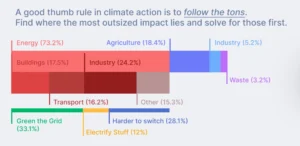
A closer look at our systems and processes, we find certain categories that are more extractive and carbon-heavy than others, such as;
- The way we power stuff; from entire cities to our phones, how these are powered
- The way we move stuff; the logistics of people, goods and resources
- The way we make and grow stuff; from how we make food to how we make our buildings.
In this article, we will look into a few tools we presently have to make the way we do these things better and to ease the climate crisis in India.
Clean Energy Tools to Fight the Climate Crisis in India
Going Macro: Clean Energy for the Entire Grid
A grid-connected system allows you to power your home or store with renewable energy when the sun is shining, the water is running, or the wind is blowing (daily and seasonally). Any excess energy you generate is fed back into the grid. When renewable resources are unavailable, electricity from the grid meets your needs, saving you the cost of energy storage devices such as batteries.
Powering Local: Microgrids and Renewable Energy
Microgrids are localized collections of power generation and storage systems that can operate independently or in tandem with the traditional grid. Microgrids are used as backup while the main grid is down or in places where grid power is not available, as well as serves as support to the grid for faster response and recovery.
Storing Clean Energy From Renewables
Power from renewables such as wind and solar can be erratic and intermittent. Therefore we need better ways to store this power when the sun is shining and the wind is blowing, and to make that stored power available to use when it’s night or if the wind stops.
- Home Batteries: These are integrated battery systems installed within your home that store solar energy from your panels, delivering the power even at night or if the grid goes down.
- Dams-as-Storage: This is pretty ingenious; when there is surplus power available, that extra power is used to pump water back into hydropower dams, and when needed, these dams release water to generate power, functioning as a massive battery.
- Vehicle to Grid (V2G): Electric vehicles are essentially batteries on wheels. And as more EVs roll out, we essentially have large storage systems available. V2G technology allows energy to be pushed back to the power grid from an electric car’s battery. So now, these cars can potentially be charged and discharged as per demand, cost of power and requirement.
- Virtual Grid: Virtual Grid takes the ideas discussed above to the next level; Instead of the typical way where the grid connects between one large power station to many homes, Virtual Grid connects all the renewables to all the storage available to all the places that needs power, making solar on your home and power stored in your neighbour’s vehicle to the factory down the lane, all part of the grid. Better yet, you get paid for the power from your solar and for using your batteries to store them.
Can’t install panels? Read How Urban India Can Fight Climate Change Without a Rooftop Solar Panel
Making Food and Buildings Better: Cutting Carbon Emissions
Better Ways to Make Food With Fewer Carbon Emissions
- Precision Agriculture: This is a farm management method that employs information technology to ensure that crops and soil receive precisely what they require for optimal health and productivity. Precision Agriculture aims to be sustainable while also lowering costs.
- Switching out of animal agriculture: Growing animals for meat and dairy is not only morally unethical to fellow living beings, but also has a massive impact on climate, as most land use and food production is done to support livestock as well as emit vast amounts of methane. Plant-Based Meats and Milk: resemble animal meat and dairy but are made from plant cultures. Newer products have been successful in mimicking its taste, texture, smell, and appearance.
- There are very high chances of loss of crops like corn, cocoa, and coffee. This is due to extreme climatic conditions such as drought, floods, and excessive pests. Meanwhile, modified crops could use less of polluting fertilisers. They could also help crops withstand these disruptions by providing pest-resistant, drought-resistant, or saltwater-resistant genes. These genes can resist saltwater intrusion from rising sea levels.
Better Construction Materials and Decarbonisation
Cement and steel production not only takes a lot of power, but also needs carbon for its process. This makes decarbonisation tricky. Some ways of making these materials is to capture the carbon as soon as they are made. Another way is to inject the carbon back into the product, making them ‘carbon sinks’. Some interesting ideas are panning out for the first part: capturing of carbon. Applications like Direct Air Capture of carbon are proving to be useful.
Electric Vehicles and the Climate Crisis in India
Individual Transportation: Electric Vehicles in India
Electrification of the mobility sector can result in increased energy efficiency and lower local pollution. In India, while there is a high level of participation from both 2 and 4 wheeler segments, surprisingly the EV revolution is led by three-wheelers (rickshaws). This shift matters for the climate crisis in India, since transport is one of the big sources of emissions. In May, the number of new electric three-wheelers (e3w) sold in the country increased significantly, rising from 50% in each of the three months until April 2022 to 56% overall.
Public Transportation: Electric Buses and Trains
As cities strive to reduce tailpipe emissions, the trend toward electrifying city-wide transportation is gaining momentum. Electric buses and trains are being introduced in almost all the big cities around the world. Beyond benefitting climate action, electric mobility can produce more power than their diesel counterparts and even more short-term surge power for fast acceleration, ideal for city-use. Cities also benefit from reduced noise and pollution.
Battery Swapping for Electric Vehicles
To address the long charging times which hinder EV adoption, some vehicle manufacturers are now opting for swappable batteries. In this case, when the vehicle is running low on power, much like how gas cars head to a petrol station, EVs go to a battery station to swap their old batteries for new ones, reducing the time to get going by a considerable margin.
Conclusion
To wrap it up, we have the tools and solutions to address the climate crisis in India. We also have them for the carbon impact of some of the biggest segments in our economy. And better tools are on their way as climate action gets the much needed spotlight and demand from consumers.
That being said, perhaps the best tools to combat climate change are the ones that we already have. To be non-extractive begins with using less stuff and by using the stuff we have for longer. Also climate change is not a solution technology alone could solve for. Being able to collect and organise ourselves and our peers is highly important. Technology could play the role of enabler through our online communities, awareness and education and by making things more transparent. Transparency not just into products and corporations, but also into campaign missions of our elected officials. And into their policies towards climate and the climate crisis in India.
For India’s renewable energy targets, see the Ministry of New and Renewable Energy (MNRE)