
How does digital solar help urban residents to participate in CE?
Rooftops in cities were never really built for solar. Between limited space, high upfront costs, and patchy sunlight, most people looking into digital solar energy and benefits are really asking one question: is there a way to get clean power without the rooftop headache? Turns out, understanding digital solar energy and benefits starts with understanding why traditional panels struggle in urban settings in the first place. This post walks through both, plus the real reasons digital solar energy and benefits are gaining traction faster than anyone expected.
Why Solar Panels Struggle in Urban Residential Areas
The sun delivers more energy in two hours than the entire world uses in a year. That’s not an exaggeration, it’s the scale we’re working with. The problem isn’t supply. It’s storage and space.
Solar panels only produce power while the sun’s out. Once it sets, output drops to zero, which leaves a gap that current battery storage hasn’t fully solved. Most storage systems available today hold limited power and take up a lot of rooftop real estate to do it.
Cost adds another layer. A full solar setup (panels, inverter, batteries, wiring, installation) runs high enough that many middle-class households simply can’t justify it. And installation itself has requirements most city rooftops can’t meet. They need direct, unobstructed sunlight for enough hours a day to actually charge the storage battery. This is where digital solar energy and benefits come into the picture.
Large-scale solar in cities runs into its own set of problems:
- Field area: panel arrays need space that dense urban planning rarely has
- Glare and misalignment: mirrors in solar thermal setups can cause damage or nuisance glare if they shift even slightly
- Traffic: maintenance vehicles add to congestion in residential neighborhood
- Materials: panel manufacturing involves non-degradable, sometimes toxic components that carry their own environmental cost
None of this means solar’s a bad idea. It means rooftop panels specifically aren’t a great fit for how cities are built.
How Digital Solar Solves These Problems for Urban Residents
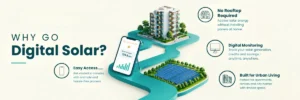
This is where digital solar changes the equation. It produces the same clean energy from the sun, without needing a rooftop army of panels to do it. It cuts greenhouse gas emissions and reduces dependence on fossil fuels the same way traditional solar does, just without the space constraints holding urban residents back.
Digitally-managed systems bring costs down and push performance up across large-scale solar projects. That efficiency trickles down to the end user. That means more stored energy, for longer. It also means far less dependence on how sunny it happens to be that week. Because digital solar doesn’t require a dedicated rooftop area, it sidesteps the space problem entirely. This is exactly why digital solar energy and benefits have become a growing focus for the solar sector. It powers everything from electric vehicles to everyday household needs more affordably.
The next challenge for the industry isn’t generating power. It’s managing massive solar installations without the cost spiraling out of control. That’s where digital twins come in software models that forecast plant failures before they actually happen, catching problems early instead of reacting to them.
Professor Bernd Engel, who leads SPE’s Digitalisation Task Force, put it simply: digitalisation gives solar “a means of integrating more PV into the grid, gaining system-wide benefits and new revenues for solar installations.” That kind of grid integration is a core piece of digital solar energy and benefits, and it’s still moving fast.
What Makes Digital Solar Different from Traditional Solar Panels
Solar panels were the obvious choice for years. They’re not anymore not when digital solar can deliver comparable output with a fraction of the physical footprint.
Digitalization pushes costs down from the ground up: less unplanned downtime, better asset reliability, more consistent long-term performance. Among the digital solar energy and benefits, maintenance needs drop too, compared to older solar technology. And critically for urban residents, digital solar doesn’t demand the sun cooperate on any particular day. It holds steady efficiency regardless of climate. It also needs nowhere near the space a physical panel array requires
A few features stand out:
- Simple, intuitive user experience
- Access and monitoring from anywhere, anytime
- Remote performance tracking for solar equipment, right from your phone
- Multi-site management for people with more than one property
Digital solar tends to cost less upfront too, and setup is far simpler than a traditional install. Some digital solar equipment is even portable; you can move it from one location to another, which a rooftop system obviously can’t do. Put together, this is where digital solar energy and benefits actually show up in daily use, not just on paper.
Smart Grids and the Future of Digital Solar Energy
Storage is where the bigger shift is happening. Smart grids paired with digitally-enabled demand response could cut curtailment power generated but wasted for solar and wind across the EU from 7% down to 1.6% by 2040. That’s a massive gain, and it addresses a problem solar farm owners in both the UK and mainland Europe deal with constantly: producing more clean power than the grid can currently use.
That’s really the throughline behind digital solar energy and benefits: solving the timing mismatch between when solar power gets produced and when people actually need it.
Conclusion
For anyone living in a dense urban area without much rooftop space (or renting an apartment altogether), digital solar energy and benefits solve the two problems traditional panels can’t: space and storage. You get renewable energy, lower emissions, and real cost savings, without needing a roof full of panels or a battery bank the size of a closet to make it work.