
Different ways to add Solar to your Home
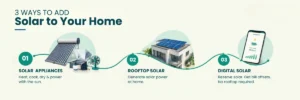
Thinking about solar panel installation for your home? Before you call a vendor, it helps to know what the installation process actually involves, what solar panel installation costs after government subsidies, and whether installing panels is even realistic for your roof. We talk to a lot of homeowners who assume solar panel installation means one standard package. It doesn’t. Your options range from small solar appliances to full rooftop systems to skipping installation altogether through digital solar, which is where we come in.
How the Solar Panel Installation Process Works
Rooftop solar follows a fairly fixed sequence, regardless of which vendor you use. First, an installer surveys your roof for shading, orientation, and load-bearing capacity. Next, you apply through your state’s DISCOM or the PM Surya Ghar national portal, since subsidy approval has to happen before installation, not after. Once approved, a registered vendor mounts the panels, wires them into an inverter, and commissions net metering so any excess power you generate flows back to the grid for credit.
The whole process, from application to a working system, typically takes four to eight weeks. Delays usually come from DISCOM approval timelines, not the physical installation itself, which can be done in a day or two for a small residential system.
Solar Panel Cost for Homes in 2026
Cost is where most people get stuck, so let’s use real numbers. Under the PM Surya Ghar Muft Bijli Yojana, the central government offers ₹30,000 per kW for the first 2 kW and a fixed subsidy of ₹78,000 for systems of 3 kW or above. A typical 3 kW rooftop system might cost around ₹1.8 lakh before subsidy; after the ₹78,000 CFA, you’re looking at roughly ₹1 lakh out of pocket, sometimes less with a state top-up.
That’s before financing. Options like the SBI Surya Shakti loan (up to ₹2 lakh at subsidized rates) or PNB’s solar power loan bring the monthly outflow close to what many households already pay in EMIs on appliances, while the electricity savings usually cover a good chunk of that EMI from month one.
For hilly states like Uttarakhand and Assam, the subsidy cap rises to ₹85,800, since installation costs there tend to run higher.
Not every use of solar energy needs a full rooftop system. Small solar appliances, like solar water heaters, cookers, or outdoor lights with embedded photovoltaic cells, need no installation process at all and can cut specific costs, like water heating, without touching your main power connection.
Full rooftop solar panel installation makes more sense when you want to offset your entire electricity bill, not just one appliance’s usage. With a 20 to 25 year panel warranty, the math tends to favor rooftop systems for homeowners planning to stay put for at least a decade. Add a battery, and you get backup power during outages too, which is the one thing our model can’t offer.
Disadvantage of Rooftop Solar Panel Installation
Here’s what most solar guides skip: installation isn’t always possible, let alone worth it.
- You rent your home. Landlords rarely approve permanent rooftop changes, and you won’t recover the installation cost if you move in two years.
- Your building has shared or shaded roof space. Apartment complexes often can’t give individual residents enough shade-free area for a meaningful system.
- You don’t own the property long-term. Solar panel costs are front-loaded; the savings arrive over 10 to 15 years.
We built SundayGrids because so many of the people we talked to fell into one of these three buckets. If any of that sounds like you, physical installation isn’t really an option, and that’s fine. It’s not a failure of planning, it’s just a mismatch between the technology and how urban housing in India actually works.
Digital Solar: Getting Solar Benefits Without Installation
This is where we step in. Instead of installing panels on your own roof, we let you reserve capacity in a commercial-scale solar project elsewhere. The electricity that project generates converts into credits, and we apply those credits directly to your existing electricity bill, no rooftop, no permits, no installation crew showing up at your door.
We link these credits to 70-plus power providers across India, including BESCOM, TPDDL, and Torrent Power. You get similar long-term savings to rooftop solar, sometimes better per-kW pricing since our projects run at a larger scale, and you can exit your reservation and get a refund if you move somewhere we don’t yet cover. What we can’t offer is backup power during a blackout, since there’s no physical system tied to your home. For renters and apartment owners, that trade-off is usually worth it.
Conclusion
If you own your home, have unshaded roof space, and plan to stay for years, rooftop solar panel installation with the PM Surya Ghar subsidy is hard to beat on long-term cost. If you’re renting, living in an apartment, or just don’t want to deal with vendors and DISCOM paperwork, we can get you most of the savings without any installation step. And if you just want to trim one specific bill, like water heating, a solar appliance might be all you need.
The honest answer is that “solar panel installation” isn’t a single decision. It’s three different products solving three different problems, and we’d rather tell you that upfront than sell you a system that doesn’t fit your situation.